

Whatever Renaissance faire you attend, it’s likely you’ve enjoyed wearing, observing, or even making hats. Renfaire garb isn’t truly complete without the proper chapeau to top off a delightful costume! From mushroom caps to crowns, you’ll spy most of the cast and the vendors wearing some manner of head covering at any Renaissance Faire. Sometimes anachronistic, sometimes historical, but very much a part of the experience, hats held a special significance in the Renaissance as well as other eras.
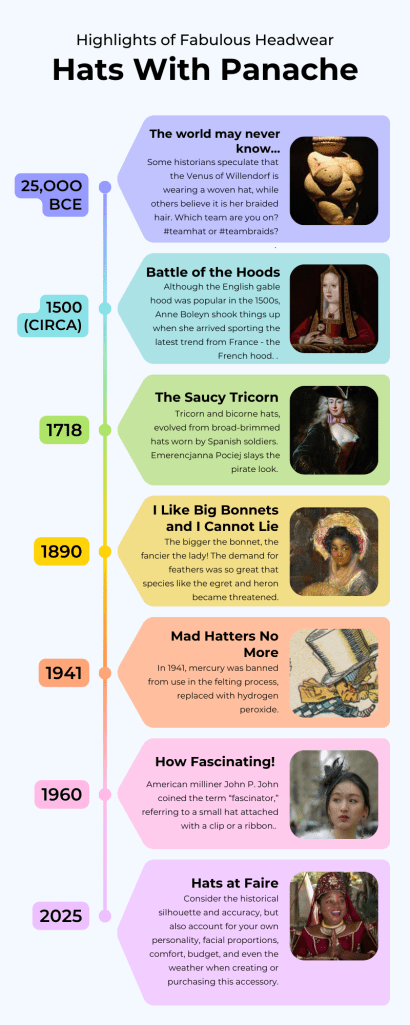
A Timeline of Toppers: From crowns to cloches, French hoods to fascinators, or hennin to baseball caps, headwear has been around since before humans began keeping written records; one of the earliest known confirmed hats dates back to the Bronze Age. Throughout history, hats have protected our heads from the elements, denoted our status in society, and been used as an art form.
Ancient History: As old as ancient Egypt, hats started as a necessity and slowly evolved into a symbol of social status, as exhibited by the Greek pileus and petasos (below, top left), and later the Roman phrygian cap. In the Middle Ages, hats for women ranged from simple scarves to elaborate hennin (below, top right), and the hat began to denote social status. These styles would influence both the headwear of the Renaissance, resulting in some of the unique styles that are popular at Renaissance Festivals today.


From Practical to Fashion Statement: During the Renaissance era, the hat evolved from a garment meant to act as insulation to a symbol of wealth and status. Especially among women, the hat became a language unto itself, with the style, color, and material telling more about the wearer than a simple conversation could. In a time where women couldn’t vote and could only hold property if their husband met an untimely demise, the hat evolved as a symbol of empowerment and expression. Hats held even more importance during the reign of Elizabeth I, when many of the styles in vogue continue to be seen at Renaissance faires today.
Signature Hat Styles of the Renaissance: As a modern Renaissance woman, which hat suits your personality best?
The Wimple: Modesty, but make it fashion.
In a time when it was considered “respectable” for married women to cover their hair, women of society elevated headwear to a whole other level. You may be familiar with the simple white wimple (below, top left) as something worn by nuns; typically a long piece of cloth draped around the neck and chin, often covering the top of the head. It’s a garment that is still a part of a nun’s clothes in modern day, as well! However, the married women of the Renaissance took this simple garment and leveled it up, using rare and more luxurious fabrics like silk and adding elaborate trim and embroidery to the garment for a bit of personality.
The Caul: For the “Working” Woman
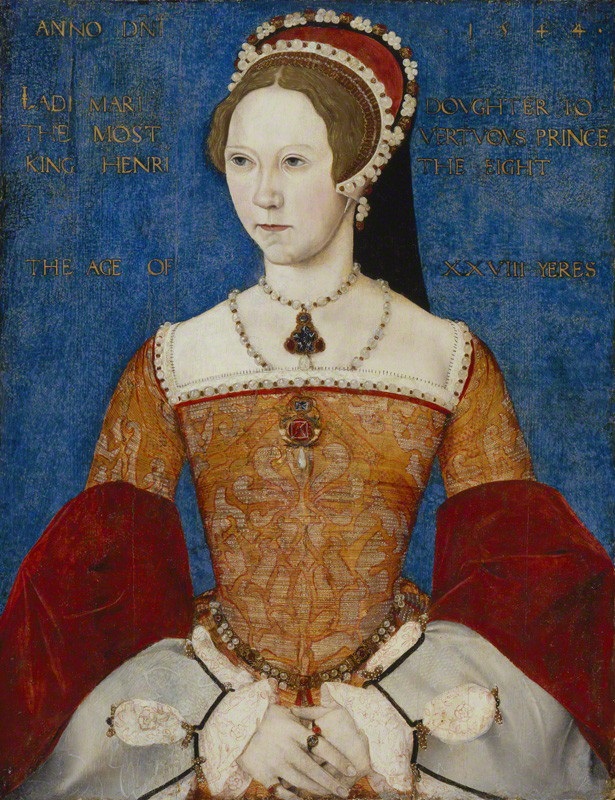
This garment appeals both to modesty and the reality of being a woman of the Renaissance, managing a household as well as children. Similar to the wimple, cauls (below, top middle left) covered up tied or plaited hair, and was held in place with a circlet or fillet. In fact, Queen Mary I wore a caul made of tinsel fabric with a golden circlet at her coronation in 1553!
The Coif: A Wardrobe Necessity
As necessary to hats as underwear is to today’s modern fashion styles, the coif (below, top middle right) was a close-fitting head covering, often made of linen, that was historically worn by both men and women, sometimes worn alone or layered under other head coverings like hoods or hats. Coifs were particularly common among peasants and laborers, and could be tied under the chin or worn in a more relaxed style.




The French Hood: Scandal and Rebellion
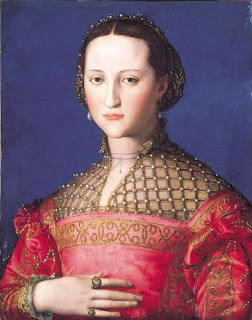
One of the most iconic headpieces seen at Renaissance Festivals, it may seem odd that the French hood (above, top right) is associated with scandal. However, this style was made popular by none other than the (in)famous Anne Boleyn. It featured a stiff frame, often trimmed with an inched edging and decorated with gold bands or billiments, and was typically black, though sometimes white or red. The hood was designed to cover the ears while exposing the wearer’s hair, something as scandalous as exposing your ankles!
The English Gable Hood: Howl’s Moving Castle, as a Hat
My favorite personal nickname for this hat is the “Birdhouse”, because that’s what it looks like to this author. The English answer to the French hood, the gable (above, bottom left) was taller and more structured than its French counterpart. The hood was often made of black fabric and featured a peak over the forehead, long lappets (decorated fabric panels) at the sides and back, and thick folds over the shoulders. If you were feeling spicy, you could even pin the fabric to one side!
The Attifet: Hopeless Romantics, Swipe Right
This hat was a darling of the hopeless romantic crowd during the late Renaissance. Characterized by a heart-shaped headdress, typically made of silk or linen, the attifet (above, bottom right) features a point which dips over the forehead; the front of the headdress was often supported by a wire frame.
Legacy
These are just a few of the styles from the Renaissance period, many of which were handmade and decorated by the women who wore them. While these specific styles may live only in historical films or Renaissance faires, hats themselves remain a social symbol of status- just look at the hats at the Kentucky Derby or the Royal Ascot races in London!
As you don your hat, whether it’s an iconic historical reproduction or just a graphic baseball cap, take a moment to appreciate the women who transformed this costume piece into a subtle expression of rebellion and found a way to speak volumes in an era that often silenced them. Perhaps these iconic styles will even inspire you to create a hat of your very own!
Hats at Faire
Whether you choose a floral garland, a French hood, or a Cavalier, we’d love to see photos of you in your hat! Send them to info@ladyfairemagazine.com to be included in our readers’ gallery! As famed gossip columnist Hedda Hopper said, you can “wear a hat or take it off, but either way, it’s a conversation piece!”

Vivian Orozco (Vixie) is a Latina tailor who has a passion for historical and multicultural clothing. She enjoys studying fashion and its historical and cultural evolution in the modern era. While pursuing a Bachelor’s degree in costume design, she discovered a passion for the clothing of the past, as well as missed opportunities in using silhouettes from around the world. In addition to costuming, Vixie is also a film maker, cosplayer, artist, content creator, and TTRPG enthusiast.
 ladyfairemagazine.com