

Across the centuries, and among many different societies, in the midst of the darkness of winter people look to kindle fire and light. Although not a high holy day, Hanukkah is a beloved Jewish holiday that has its roots and meaning in a historical event.
The events are recorded in Maccabees I and II, found in the Apocrypha, and tell of the time in 168 B.C.E. when Syrians led by their king Antiochus Epiphanes attacked Jerusalem and desecrated the Temple. Judaism was outlawed, and the Syrians offered Jews the choice to convert or be put to death.
The Hasmoneans, or Maccabees, resisted and led by Judah Maccabee, defeated the Syrian Greek army in two battles. Thus this example of fighting for identity and religious and political freedom has become an important reminder of the power of faith and resistance to assimilation. After the Syrians left, the Temple needed to be purified and rededicated. The word “Hanukkah” means dedication, and the eight-day celebration of the rededication of the Temple also marks a time for Jews to rededicate themselves to the preservation and practice of their religion and culture. Rabbi David Hartman writes that the holiday is a celebration of “our people’s strength to live without guarantees of success”.

There is no mention in the books of Maccabees of the legend of the miracle of the oil. Centuries later the story appeared in the Talmud. The legend states that when the Maccabees went to relight the ner tamid (Eternal light), which hangs above the ark in synagogues, they had only one jar of oil. They sent someone out to get more oil, but he took 8 days to return. Miraculously, the one jar of oil lasted and the light continued to burn until the oil could be restocked. Palestinian sources add that the eight days are because the Maccabees found eight spears and fixed the lights on them, and it is Babylonian sources that give us the story of the oil. It is now accepted by most scholars that the celebration is patterned on the feast of Tabernacles.
By and large, the Renaissance was a difficult period for Jews in much of the Western world. They were expelled or forced to convert in England beginning in 1290 and Spain in 1492. The Crusades saw the destruction of Jewish communities in what is now Germany. Between 1450 and 1570 expulsions from Portugal, southern Italy, Provence, and the Holy Roman Empire resulted in the Ashkenazim settling in Poland and Lithuania , and the Sephardim going to India, the Americas, the Ottoman Empire, and Morocco. Jews in Italy were confined to ghettos. Hanukkah celebrations of the time are largely undocumented, with the lighting of the menorah being the one constant.
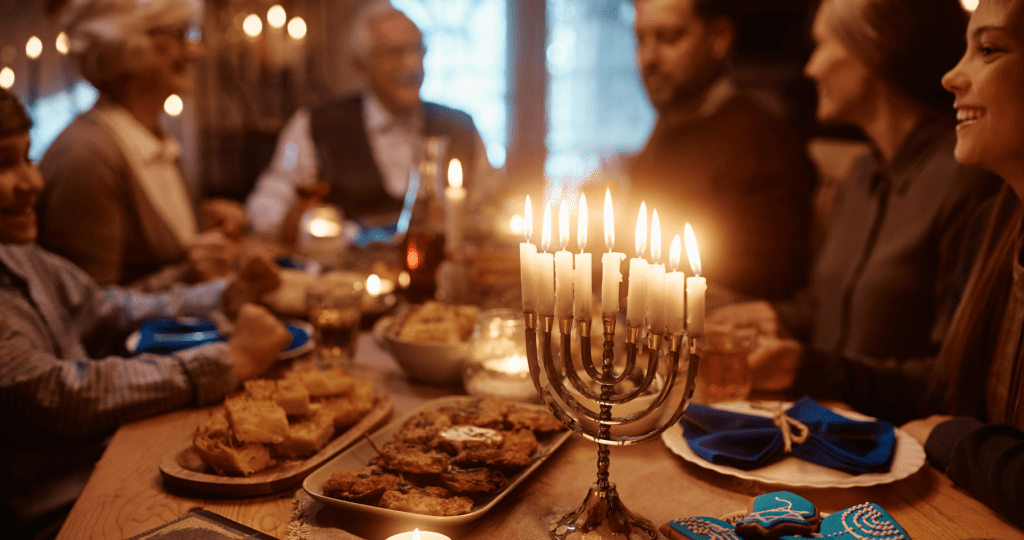
The best-known element or symbol of the holiday is the menorah, or hanukkiah, which calls to mind the menorah that was in the Temple. The eight days are symbolized by the eight branches of the menorah, with four on each side and a central holder for the shamash candle, used to light the candles/oil each night of the festival. As part of the celebration, Jewish families play dreidel. with the four-sided top that has the Hebrew letters nun, gimmel, hey and shin, which stand for gadol haya sham (“a great miracle happened there”). It is believed that when Jewish learning was forbidden, the dreidel was used as a cloaking device; they weren’t studying Hebrew, they were just playing a game! Because of the connection between oil and the holiday, it is traditional to cook food in oil. Latkes, potato pancakes, and sufganiyot, jelly donuts, are popular choices.

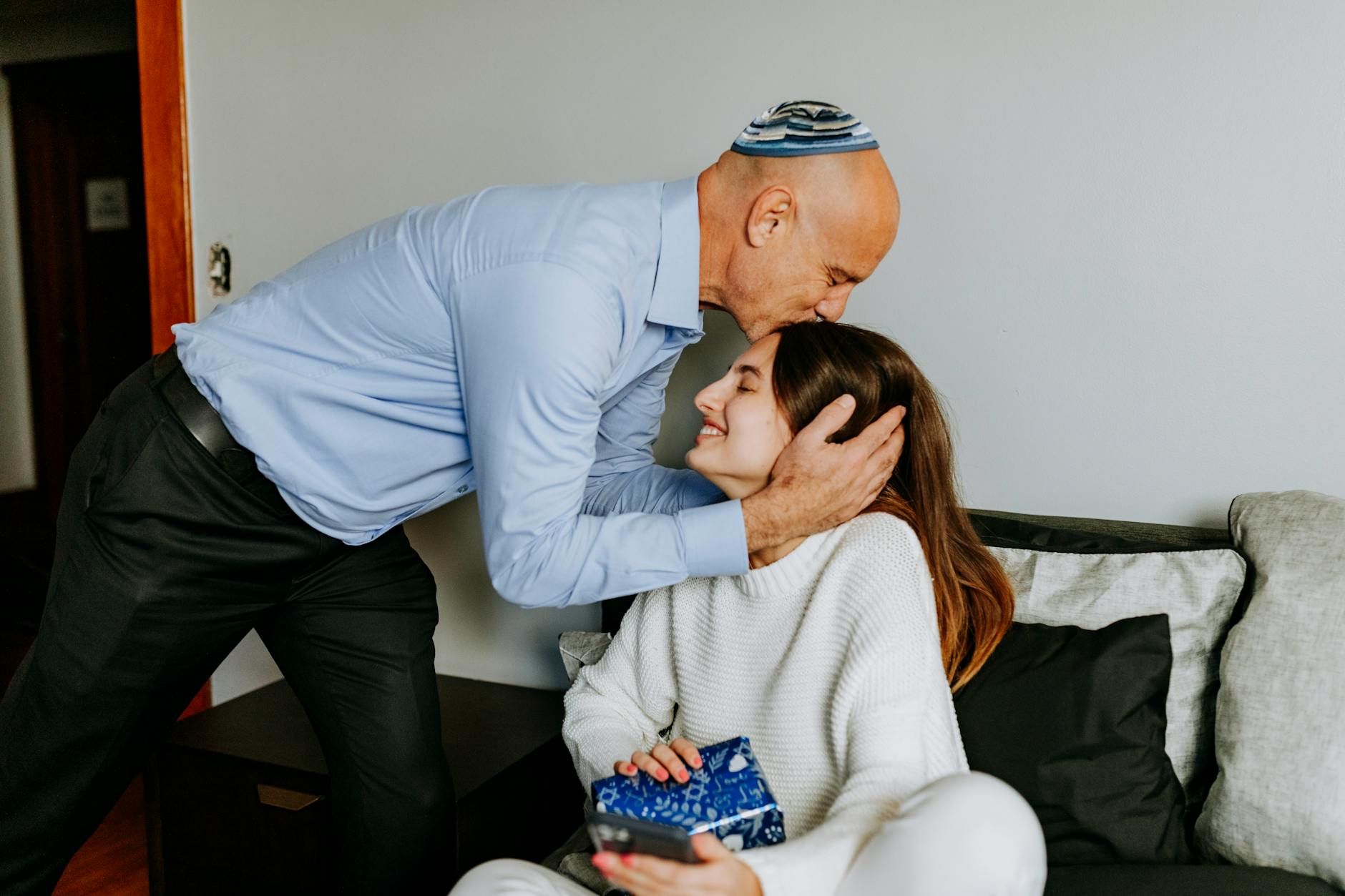

In the modern Western world, the festival of lights has become both better known and commercialized; a mixed blessing for Jews who want to preserve the holiday as an expression of their religion and culture and not “Jewish Christmas”. It is now possible to see Hanukkah merchandise alongside Santa and Christmas trees, and modern media means that Jewish families can enjoy movies and songs that reflect their celebration. However, the beauty of the eight days lies in the connection of a rich heritage with family and friends as they gather in the glow of the menorah.

Christine Boyett Barr is an award-winning journalist and English instructor, teaching high school and college English. In addition to her pedagogical pursuits, she hosts movie events for the Alamo Drafthouse Cinema and portrays Catherine of Aragon at the Texas Renaissance Festival. She is the mother of four and is owned by two cats.
Works Consulted
“History: The Hanukkah Story.” Reform Judaism, Union for Reform Judaism , 2025, reformjudaism.org/jewish-holidays/hanukkah/history-hanukkah-story.
Israel , Steve. “Jews in Europe, a Unique Story in Space and Time.” European Jewish Heritage, European Association for the Preservation and Promotion of Jewish Culture and Heritage (AEPJ), 20 Sept. 2021, jewisheritage.org/european-routes/jews-in-europe-a-unique-story-in-space-and-time.
My Jewish Learning. “Symbols of Hanukkah.” My Jewish Learning, 6 Dec. 2022, http://www.myjewishlearning.com/article/symbols-of-hanukkah/.
Wein, Berel adapted by Yaakov Astor. “The Jews and the Renaissance.” Jewish History | We Bring Jewish History To Life, Jewish History , 26 July 2021, http://www.jewishhistory.org/the-jews-and-the-renaissance/.
Zeitlin, Solomon. “Hanukkah: Its Origin and Its Significance”. The Jewish Quarterly Review, New Series, Vol. 29, No. 1 (Jul., 1938), pp. 1-36 (36 pages)https://www.jstor.org/stable/1452161
 ladyfairemagazine.com